What Is an LCMHC? How to Check a Therapist’s License in North Carolina
You open a therapist’s profile and see “MA, LCMHCA” after the name. What is an LCMHC? LCMHC stands for Licensed Clinical Mental Health Counselor, North Carolina’s license for professional counselors. The MA is a master’s degree, not a license.
An A at the end of LCMHC means an associate who practices under supervision, and an S means a supervisor approved by the state board. You can check all three in the board’s free online search.
What Do LCMHC, LCMHCA and LCMHCS Mean?
All three titles come from the North Carolina Board of Licensed Clinical Mental Health Counselors, and each marks a different level:
- LCMHCA (associate). Since July 1, 2022, applicants need 60 or more semester (or 90 quarter) hours of graduate training, with a counseling master’s degree or one in a related field, and a passed exam. An associate may counsel only under supervision.
- LCMHC. The full license. Associates apply once they have finished, or nearly finished, 3,000 hours of practice under supervision, and they keep that supervision until the board issues it.
- LCMHCS (supervisor). An LCMHC whom the board has approved to provide clinical supervision.

The last letter tells you the level of the license.
These letters are protected. State law makes it unlawful for anyone without the license to use “LCMHCA,” “LCMHC” or “LCMHCS.”
Before January 1, 2020, the same licenses were called LPCA, LPC and LPCS, so you may still see those letters on older documents. Other states use their own titles for professional counselors, such as LPC, LMHC or LPCC.
How to Look Up Your Therapist’s License in North Carolina
For an LCMHC, LCMHCA or LCMHCS, the check runs through the counseling board’s free search.
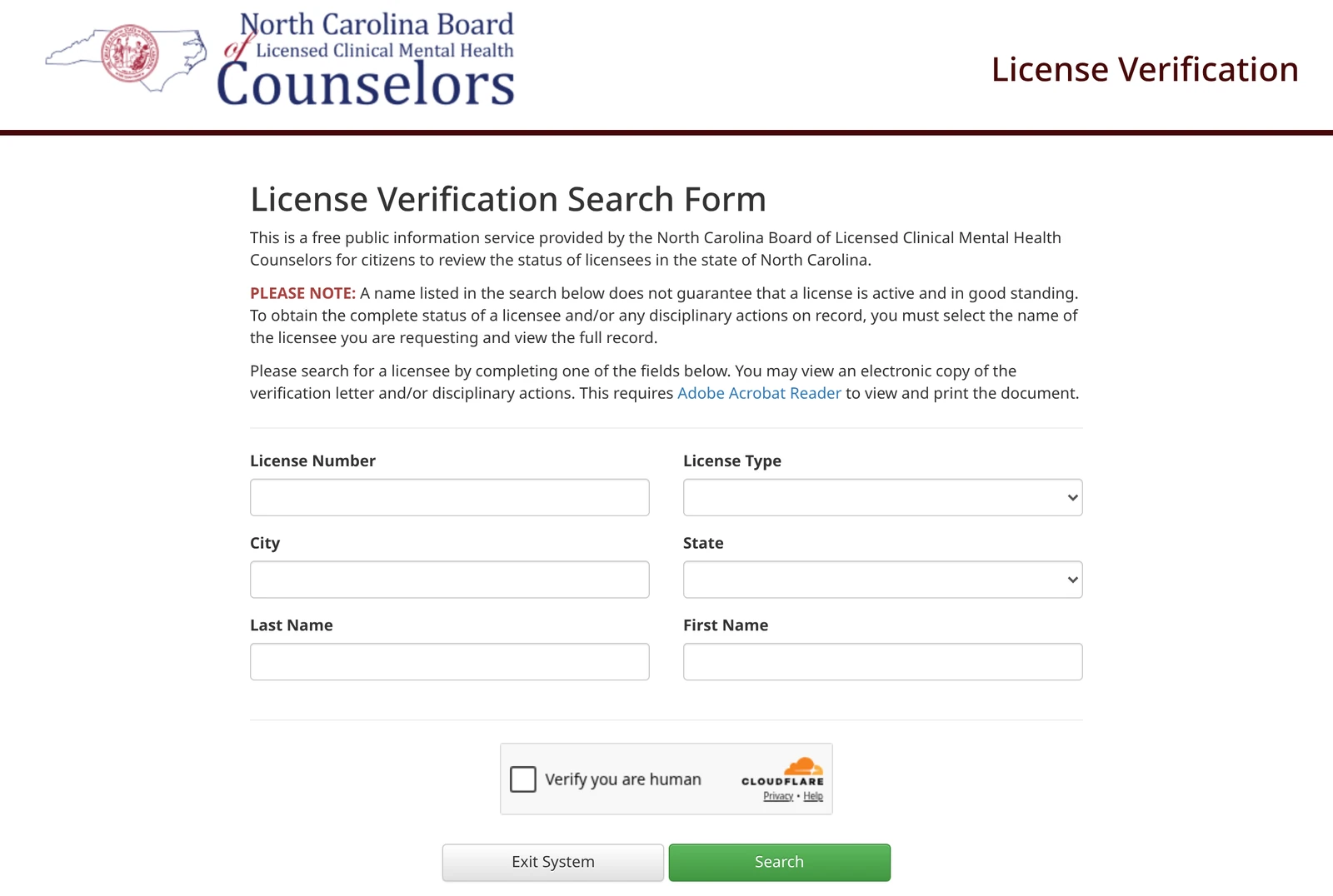
The board’s search form. One filled field is enough to run a search.
- Find the license number. North Carolina counselors must give you a Professional Disclosure Statement before counseling begins. The board’s instructions say it lists the counselor’s licenses with their numbers, and an associate’s statement names the current supervisor. No statement yet? Ask for the number.
- Open the board’s License Verification page. One field is enough, such as the number or a last name. If the list runs long, add a first name or a city: the search shows only the first 100 results.
- Read the list. Each row shows the number, name, status, city and state. The board gives associates numbers that start with an A, such as A0000.
- Open the full record. The board warns that a name on the list “does not guarantee” an active license in good standing. Click the name to see the complete status and any disciplinary actions, and to view an electronic copy of the verification letter.
- Read any discipline next to the status. The board lists its disciplinary actions since 2005, and they stay in the license history. Some people on that list may have met the board’s requirements since, so check the current status to see where the license stands now. The board investigates only written, signed complaints, and your disclosure statement explains how to file one.
You can read other state license records the same way, including a contractor’s. Legit Pages applies this to contractor licenses in California. Its guides go through each part of the record, from status to bonds and discipline, and point to the public source behind every answer.
Not an LCMHC? Which North Carolina Board Licenses Each Title
Other therapy titles come from other boards, and each board has its own search. Start with the letters after the name.
|
Letters |
What they mean |
North Carolina board |
Where to look |
|---|---|---|---|
|
LCMHC, LCMHCA, LCMHCS |
Counselor (full license); associate; supervisor |
Board of Licensed Clinical Mental Health Counselors |
ncblcmhc.org, “Verify a License” |
|
LCSW, LCSWA |
Clinical social worker; associate |
Social Work Certification and Licensure Board |
ncswboard.gov, “License Lookup” |
|
LMFT, LMFTA |
Marriage and family therapist; associate |
Marriage and Family Therapy Licensure Board |
ncbmft.org, “Verify a Licensee” |
|
Licensed Psychologist, LPA |
Psychologist; psychological associate |
Psychology Board |
ncpsychologyboard.info, “License Verification” |
For social workers and family therapists, the A also means supervised practice. For psychological associates, it no longer always does: since October 1, 2025, an LPA with 4,000 supervised hours may apply to practice independently. State law also lets an LPA use the word psychologist, so check which license the board lists.
Some older guides still list former web addresses for some of these boards, so start from the sites above. In another state, look for the board by license type. For social workers, the Association of Social Work Boards keeps links to state license searches.
Can a Therapist Licensed in Another State See You Online?
Where you are during the session matters. North Carolina’s counseling board says counseling takes place both where the counselor is and where the client is. To counsel someone in North Carolina, a person needs a license from that board or an exemption under the state’s counseling law.
The other boards are just as direct. The social work board says practicing without a North Carolina license is unlawful, telehealth included. The family therapy board does not authorize teletherapy by therapists licensed only in other states.
Interstate compacts are the exception. North Carolina belongs to PSYPACT, the compact for psychologists, in effect here since March 1, 2021. It lets psychologists with a PSYPACT authorization practice telepsychology in other member states, within the compact’s limits. PSYPACT’s site has a page to verify those authorizations.
The Counseling Compact is a different story. North Carolina is on its member list, but as of October 2026 the compact is live in 11 states, and North Carolina is not one of them. So, for now, it does not give out-of-state counselors a way to see clients here.
A therapist may hold licenses in more than one state, so ask which one covers your sessions, then check it the same way. If you plan to join a session from another state, mention it ahead of time.
Final Thoughts
The letters after a therapist’s name tell you which board to ask. The board’s record shows whether that license is current and whether the board has acted on it. Your disclosure statement fills in the rest, including who supervises an associate. You can ask about any of this before your first session.
FAQs
1. Is an LCMHC the same as an LPC?
In North Carolina, LCMHC is the current name of the license that was called LPC until January 1, 2020. Elsewhere, LPC, LMHC and LPCC are titles that different states use for professional counselors, each under its own rules.
2. Is an LCMHC or an LCSW higher?
The two licenses are not steps on one ladder. An LCMHC is licensed by the counseling board, and an LCSW by the social work board. Each is the level where supervision is no longer required, and each has a supervised associate level: LCMHCA and LCSWA.
3. What if I cannot find my therapist in the search?
Check the spelling, or search by license number instead of name. If nothing comes up, your therapist may hold a license from another board in the table above. Ask which board issued it, then search that board’s site.